• About Tuzla

    Tuzla city is situated in north - east part of Bosnia and Herzegovina, it's administrative center of Tuzla Canton, and economic, scientific, cultural, educational, health and tourist centre of northeast Bosnia.

  • University of Tuzla

    University of Tuzla (est. 1976) is public university located in Tuzla. It's the most important and major educational and scientific institution in northeast Bosnia.

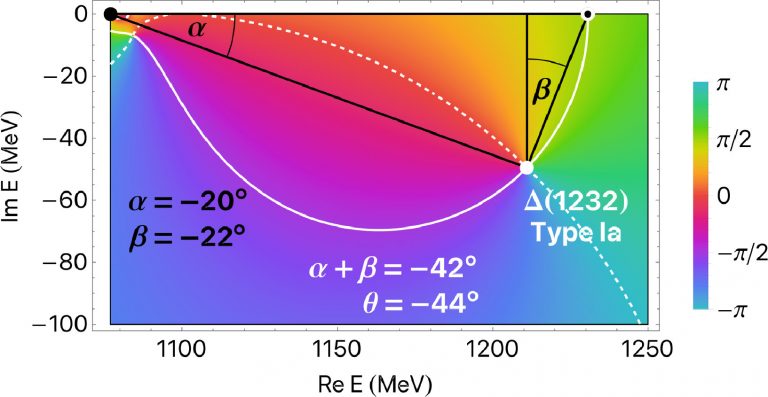
No hidden physics in resonance pole residue phase

New publication: 

S. Ceci, R. Omerović, H. Osmanović, M. Uroić, B. Zauner, No hidden physics in resonance pole residue phase, Physics Letters B, 2025, 140136, ISSN 0370-2693,
https://doi.org/10.1016/j.physletb.2025.140136
(https://www.sciencedirect.com/science/article/pii/S0370269325008925)

 
Abstract: In hadron resonant scattering, there are four fundamental resonant parameters: real and imaginary parts of the pole position, and the magnitude and the phase of the residue. Out of the four, the last one is the least understood. The search for the residue phase’s physical meaning has focused on model-independent phases of the majority of the lowest-mass resonances. Here, we apply a simple mathematical identity to the amplitude in the complex plane to reveal the exact reason for the noticed regularity and show that there is no room for hidden physical variables in the residue phase.
Keywords: Resonant scattering; Unitary S-matrix; Resonant properties; Baryon and meson resonances


Share:

ANU BiH: Susreti mladih istraživača BiH iz STEM oblasti

 Susreti mladih istraživača Bosne i Hercegovine iz oblasti prirodnih, tehničkih i matematičkih nauka (STEM) održani su 3. i 4. novembra 2023. godine u organizaciji Odjeljenja tehničkih nauka Akademije nauka i umjetnosti Bosne i Hercegovine i u saradnji s Federalnim ministarstvom obrazovanja i nauke.

Jedan od glavnih ciljeva ovog skupa bio je uspostavljanje kontakata s mladim istraživačima porijeklom iz Bosne i Hercegovine koji djeluju u STEM oblastima na univerzitetima i istraživačkim institucijama u svijetu.

Skup je prvenstveno bio namijenjen studentima doktorskih studija u STEM oblastima i mladim istraživačima koji su doktorirali u posljednjih pet godina, ali i svim zainteresiranim istraživačima, članovima akademske i naučne zajednice u Bosni i Hercegovini te predstavnicima bh. privrede.

Skup se sastojao iz tri dijela: dva pozivna predavanja koja su održali gospodin Namik Hrle, inostrani član ANUBiH, IBM Fellow, direktor IBM-ovih globalnih razvojnih timova iz područja baza podataka i umjetne inteligencije i direktor IBM-ove najveće razvojne laboratorije u Njemačkoj i Suad Krilašević, doktorand na Tehničkom univerzitetu u Delftu i predsjednik Asocijacije za napredak nauke i tehnologije u Bosni i Hercegovini.

U drugom dijelu skupa predstavljeno je 28 prezentacija istraživanja studenata III ciklusa i mladih istraživača koji su doktorirali u proteklih 5 godina. Naučni odbor skupa dodijelio novčane nagrade za najbolje prezentacije istraživanja.

Detaljnije na LINKU!


Share:

KLF Collaboration

At the first stage the KLF (K Long Facility) program will focus on two-body and quasi-two-body reactions: elastic $K_L p → KS_p$ and charge-exchange $K_L p → K^+ n$ reactions, then on two-body reactions producing $S = −1$ ($S = −2$) hyperons as $K_L p → π + \Lambda$, $K_L p → \pi+Σ^0$ , and $K_L p → π^0 \Sigma^+ (K_L p → K+Ξ 0 )$, as well as three body $K_L p → K^+ K^+ \Omega^ −$.

A coupled channel PWA of the KLF data can be performed standalone and in conjunction with an analysis of the data from the J-PARC K−p measurements, if available. The best fit will determine the partial wave amplitudes and the resonance pole positions, residues and Breit-Wigner (BW) parameters. These will provide a benchmark for results of forthcoming Lattice QCD calculations and elucidate the structure of the strange hyperons.

PWA Tuzla Group is a part of the KLF Collaboration.


Share:

STRONG 2020 Workshop


STRONG 2020 (14-16 September - University of York) is included in the activities of the working package WP25 (Light-and heavy-quark hadron spectroscopy) of the project STRONG-2020. It has received funding from the European Union’s Horizon 2020 research and innovation programme under grant agreement No 824093.

POSTER: SE  PWA for pion photoproduction with vfixed-t analyticity

The major topics of the workshop will cover:

1) Precision calculations in non-perturbative QCD: Effective Field Theories, analyticity, dispersion relations and Lattice QCD

2) Spectroscopy & Exotic states

3) Hadron Decays & Production

4) Form factors, LECs, fundamental parameters of QCD and light nuclei
spectroscopy

Share:

Single-energy partial-wave analysis for pion photoproduction with fixed-t analyticity

Received 15 July 2021

Accepted 20 August 2021

DOI:https://doi.org/10.1103/PhysRevC.104.034605

©2021 American Physical Society

Abstract

Experimental data for pion photoproduction including differential cross sections and various polarization observables from four reaction channels, $\gamma p \rightarrow \pi^0 p$, $\gamma p \rightarrow \pi^+ n$, $\gamma n \rightarrow \pi^− p$, and $\gamma n \rightarrow \pi^0  n$, from threshold up to W= 2.2 GeV were used in order to perform a single-energy partial-wave analysis with minimal model dependence by imposing constraints from unitarity and fixed-t analyticity in an iterative procedure. Reaction models were only used as a starting point in the very first iteration. We demonstrate that with this procedure partial-wave amplitudes can be obtained which show only a minimal dependence on the initial model assumptions. The analysis was obtained in full isospin, and the Watson theorem is enforced for energies below W= 1.3 GeV but is even fulfilled up to W≈ 1.6 GeV in many partial waves. Electromagnetic multipoles $E_{ℓ\pm}$ and $M _{ℓ\pm}$ are presented and discussed for S, P, D, and F waves.


Share:

Single-energy partial wave analysis for π0 photoproduction on the proton with fixed-t analyticity imposed

  • Received 16 August 2019

DOI:https://doi.org/10.1103/PhysRevC.100.055203

©2019 American Physical Society


Abstract 

High-precision data of the $\gamma p \rightarrow \pi^0p$ reaction from its threshold up to W=1.9GeV have been used in order to perform a single-energy partial-wave analysis with minimal model dependence. Continuity in energy was achieved by imposing constraints from fixed-t analyticity in an iterative procedure. Reaction models were only used as starting point in the very first iteration. We demonstrate that, with this procedure, partial-wave amplitudes can be obtained which show only a minimal dependence on the initial model assumptions.


Share:

KLF Collaboration

K Long Facility

About PWA TUZLA

We are theoretical physicists at Faculty of Natural Sciences and Mathematics - University of Tuzla. Our group is a part of the Mainz - Tuzla - Zagreb Partial Wave Analysis collaboration.

As a part of the MTZ PWA, our results are "above the line" in PDG library.

Related sites

Physics Department >>
University of Tuzla >>
PMF Tuzla >>
Mainz-Tuzla-Zagreb PWA >>
PDG - Particle Data Group >>
MAID Mainz >>
GWU/SAID Washington >>
Bonn-Gatchina PWA >>
JPac Center Indiana Uni. >>
CLAS Phy. Database >>
JPac Center Indiana Uni. >>
ETA MAID 2018 >>
Jülich-Bonn-Washington Collaboration >>

Popular Posts